On June 12, the “Contemporary Silk Road” Chinese Workshop, jointly established by Xi’an Shiyou University, the Social Protection Agency of Uzbekistan, the Center for Language Educationand Cooperation, Ministry of Education of China, and China–Uzbekistan Natural Gas Pipeline Co., Ltd., was officially inaugurated in Tashkent following the signing of a cooperation agreement.The unveiling ceremony was attended by Sharifkhodjayev, Deputy Director of the Social Protection Agency of Uzbekistan; Yu Tianqi, Deputy Director of CLEC; Liu Zhiguang, General Manager of China–Uzbekistan Natural Gas Pipeline Co., Ltd.; and Zhang Rongjun, Vice President of Xi’an Shiyou University.
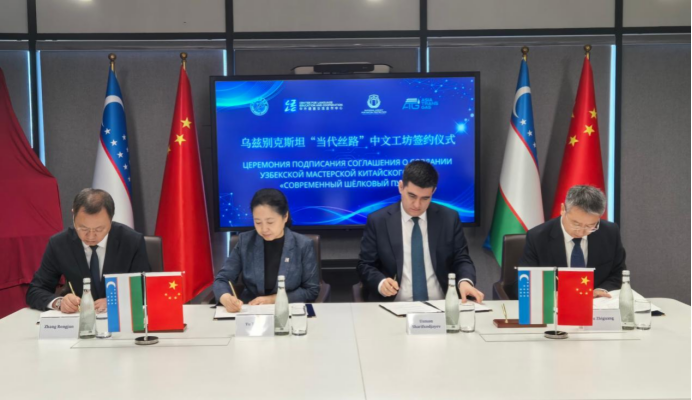
In his remarks, Sharifkhodjayev expressed appreciation to all partners for their joint efforts in establishing the workshop. He introduced the responsibilities of the International Cooperation Center under the Social Protection Agency of Uzbekistan and noted that the workshop would serve as an important platform for young people in Uzbekistan to learn Chinese, develop professional skills, and participate in practical training. He also expressed the hope that the successful launch of the workshop would open the door to broader and deeper cooperation among all partners.
Yu Tianqi stated that the establishment of the Contemporary Silk Road Chinese Workshop represents a concrete step toward carrying forward the Silk Road spirit and deepening educational cooperation between China and Uzbekistan. She expressed three expectations for the workshop: first, to align with the needs of industry by integrating Chinese language education with vocational training, thereby cultivating professionals to support bilateral cooperation in the energy sector; second, to leverage Xi’an Shiyou University’s academic strengths and educational resources to contribute to local economic and social development as well as China–Uzbekistan economic and trade cooperation; and third, to serve as a bridge for cultural exchange by organizing regular Chinese language learning and Chinese culture experience activities, fostering mutual understanding and friendship between the peoples of the two countries, and contributing to the building of a China–Uzbekistan community with a shared future.
Liu Zhiguang noted that China–Uzbekistan Natural Gas Pipeline Co., Ltd., as an integral part of the China–Central Asia Natural Gas Pipeline, is a landmark strategic project jointly promoted by the leaders of China and Uzbekistan and a model of energy cooperation under the Belt and Road Initiative. Over the years, the company has fulfilled its social responsibilities by training a large number of technical and managerial professionals for Uzbekistan. He said that jointly establishing the Chinese Workshop marks an important extension of bilateral energy cooperation into the field of education. Centered on the integration of Chinese language learning and vocational skills training, the workshop will not only promote cultural exchanges between the two countries but also cultivate skilled professionals to meet the needs of Uzbekistan’s energy industry and support local economic and social development.
Zhang Rongjun emphasized that the signing of the agreement marks another significant achievement in educational and people-to-people cooperation between China and Uzbekistan. As the world’s first Chinese Workshop jointly established with the direct participation of a foreign government agency, the Contemporary Silk Road Chinese Workshop is designed to meet the practical needs of Chinese enterprises operating in Uzbekistan and local social development. It aims to cultivate versatile local professionals equipped with both Chinese language proficiency and specialized technical expertise, pioneering a new model of China–Uzbekistaneducationalcooperation featuring government-university-enterprise collaboration and industry-academia-research integration.He added that, guided by the principle of openness and mutually beneficial cooperation, Xi’an Shiyou University has actively participated in educational cooperation under the Belt and Road Initiative. Over the past75 years, the University has educated more than 10,000 international professionals for the global energy sector. Looking ahead, the University will continue working closely with its partners to improve mechanisms for jointly developing, sharing, and utilizing teaching resources, with the goal of building the workshop into a flagship project for China–Uzbekistan educational cooperation.
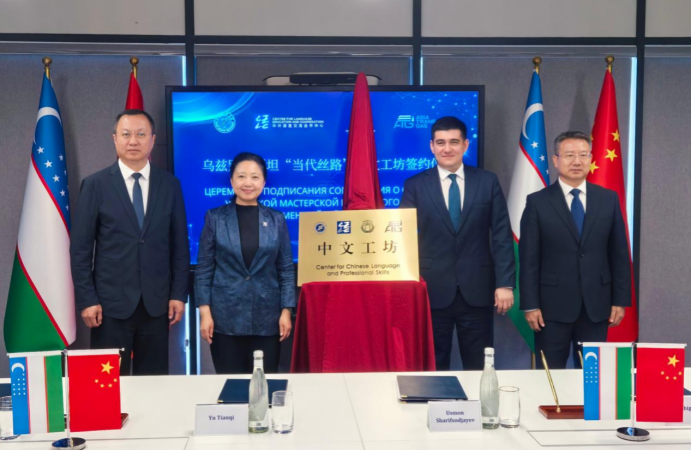
Following the signing ceremony, representatives of the four parties jointly unveiled the plaque of the Contemporary Silk Road Chinese Workshop.
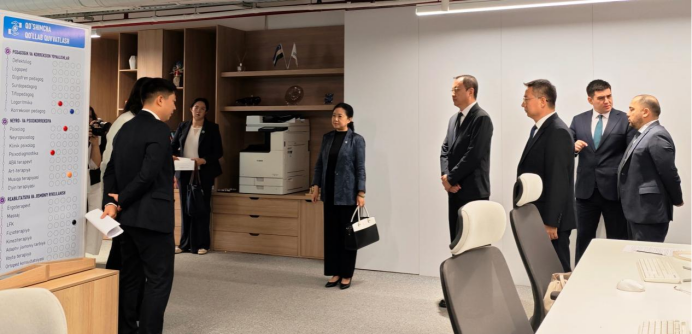
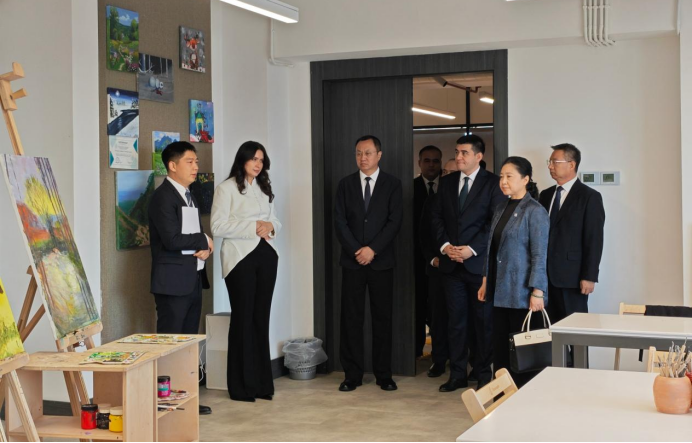
After the ceremony, the participants toured the workshop and exchanged views on its future development and operational plans.
Background
The Chinese Workshop is a flagship international Chinese language education initiative launched by the Center for Language Education and Cooperationunder China’s Ministry of Education. Closely aligned with the high-quality development of the Belt and Road Initiative, it adopts an innovative “Chinese + Vocational Skills” model to integrate language education with professional training. Guided by the principle of being small in scale, practical in approach, and sustainable in development, the program serves as an international cooperation platform jointly supported by governments, educational institutions,and enterprises to promote Chinese language education and industry-oriented skills training in Belt and Road partner countries.
Preparations for the Contemporary Silk Road Chinese Workshop began in 2024. In 2025, the Social Protection Agency of Uzbekistan officially joined the initiative, establishing a four-party cooperation framework that made the workshop the first Chinese Workshop jointly developed with the direct participation of both Chinese and foreign government institutions. In March 2026, the four partners completed the revision of the cooperation agreement, laying a solid foundation for the workshop’s official launch.


